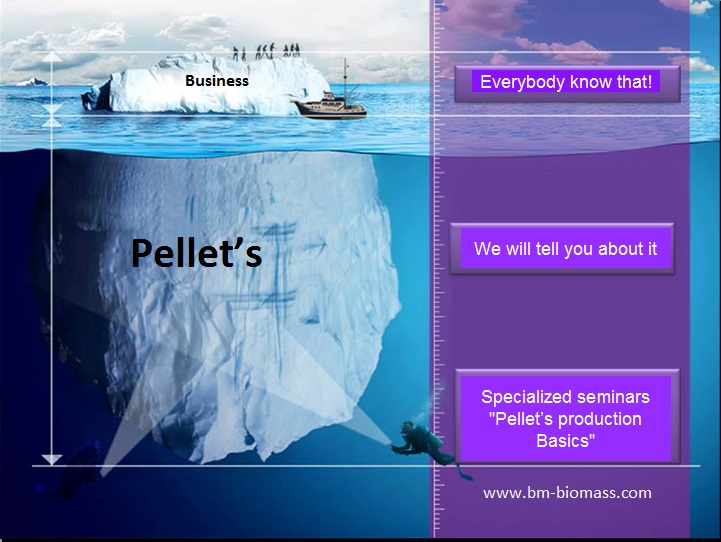
Pellet’s business

26-pel-biznes

zag-pel

Even 20 years ago, there was not a separate industry as pellet’s. Then, in the EU and in North America companies only began to produce small quantities of wood pellets and mainly for domestic use. Now in the EU establishing of the industry sector ended.

In many countries pellet’s plants work successfully. People are accustomed to use extensively white wood pellets for heating houses and water heating. At large thermal power plants and heat stations burn low-quality gray pellets in large quantities. At many plants the waste is compressed and sparingly used for technological needs. It is clear, that the fight for the environment, reducing carbon dioxide emissions, fossil fuel prices lifting have yielded results. Pellet’s business successfully works or is in the formation process in many countries.

Distinctive features of the pellet’s industry:

  • The existing resource base using. It previously was simply waste, polluted the environment, require disposal and did not bring any profit;
  • New technologies for processing biopolymers with full biorefining (four redistributions) development;
  • New markets for finished goods development (from energy to domestic use);
  • New and unique eco-friendly construction materials creating, valuable organic chemicals production, and exclusion traditional fossil fuels from energy balance;
  • Industry sector high profitability, introducing the newly created technologies and a high level technological processes automation. The industry there is not old, poorly automated enterprises. Those companies that are using the wrong technologies that are not appropriate to the kind of the feedstock and its physicochemical properties, simply can not compete in this market, and will cease to exist.

The future will show our pellet’s business successfulness! We have no doubt his viability and success.

Specialized seminar «Pellet’s production industrial engineer»

18-ind-ingen 19-ind-ingen

Pellet’s production industrial engineer: activities description, job placement, basic requirements.
Biological raw materials (biopolymers) physical and chemical properties. Biomass Pelletization Technology: advantages and disadvantages.
New approaches to biomass grinding. The processing line for pellet’s production. Basic equipment. Engineering calculation of the manufacturing process and the negative consequences of incorrect calculations. Technical and economic analysis. Production and products certification basis.

At the seminar «Pellet’s production industrial engineer» we are ready to train higher technical educated specialists of various
professions: chemical or mechanical engineers, machine builders, food production process engineers, agriculture engineers,
specialists in bioengineering.
When, after our lectures and familiarity with working pellet’s production line, our listeners begin correct and deep understand
all modern various types of biomass processing principles, they will completely mastered in our approaches and principles.
What is the basis of our biomass processing technologies, we teach you:
 vegetable biological raw material is a mixture of biopolymers with different structure. To its processing (grinding and
subsequent pressing) you must approach taking into account the physicochemical and rheological biopolymer’s properties.
Not dried before grinding, use the wet raw material shearing which generates heat by mechanical the cell mass layers
relative displacement;
 in advance it is necessary to calculate each type of raw material processing regime, fulfill the specific equipment test
operation and choose the best processing mode. For conventional equipment, which is intended for dry material pressing,
such target setting can not be performed. It’s operation requires significant energy costs and additional maintenance
services;
 the recycling process is completely automated and does not require the personnel constant presence;
 in the case of a failure power blackout we provide the press cavity mechanical cleaning possibility. It allows continue it’s
operation after the power will be restored. Cold shredded biomass in the cavities of old equipment, resulting to all line
failure, complex and expensive recovery units and parts.
Technologists, who have been trained at our specialized seminar, never will use outdated inefficient
technologies. They will be able to organize at your enterprise profitable and modern pellet
production!


Courses for Quality pellet production Managers


22-qal-men 23-kurs-qal-men

Solid biofuels production engineering
1. Biomass Types and Properties.
2. Technologies and engineering instrumentalities for biomass
preparation, processing and using.
3. Technologies and engineering instrumentalities for biomass pressing
and pelletization.
4. Biomass Torrefication. Moist Pressing Technology.
5. Cost-effectiveness of biomass using.
Quality Management System
1. General information about merit rating and quality management.
2. History of the science of quality.
3. The process and characteristics of quality management.
4. Quality Management Methodical Bases.
5. Quality Management based on ISO 9000.
6. Processes and systems approach to Quality Management.
Approximate struc ture of the t raining program
Pellets Certification System
1. Certification System. Pellets Quality.
2. The Certificate.
3. The certificate seal. Following and transparency.
4. The administration of complaints procedure.
Payments.
The list of organizations that certify,
verify and test the pellet production.
5. Pellets Producers Requests. Pellet Manufacturing
Inspections.
6. Quality management of pellets producers.
7. Pellets Traders Requests.
8. Pellets Traders inspection tests.
9. P ellets Traders Quality Management.
10. Testing Pellets Methods and Tools

Seminar Biorefayning for agricultural sector

24-bioref 25-bioref

Raw materials

  • Wood’s Biorefayning in the Forestry
  • Agricultural raw material’s Biorefayning
  • Energy crops growing in the Agriculture and Forestry
  • The Biomass Waste local occurrence in Agriculture and Forestry
  • Harvesting and storage technologies of biomass. Logistics

Biomass processing

  • Classical processing technology
  • Melting Method Processing Technology
  • Processing Cost-effectiveness

Alternative Energy Sources

  • Biogas Plants
  • Liquid biofuels
  • MSW processing(municipal solid waste)
  • Hydropower engineering
  • Geothermal engineering
  • Solar power engineering
  • Wind power engineering

Power Generation

  • Cogeneration in Power Generation

Solid Biofuels (SB)Selling and using

  • Energy audit
  • Transportation and Storage Logistic
  • Biomass burning
  • Gasification
  • Layerwise Firing Circuit
  • Solid biofuels Sale, Logistic Warehouses, Exchange
  • Technological stages in the biomassprocessing.Internal and external market SB consumption

Topical Problems

  • Enterprise Energy audit
  • Grain dryers transfer on alternative fuel
  • Solid waste fuels from manufacturing waste (dead waste, disposal fields)
  • Wind belt Reclamation(Forest plantations)
  • Cane Harvesting
  • Tops and Roots
  • Pellet’s production, questions from A to Z
  • Biochar

In the harvesting process and agricultural products processing we remain solid waste. In
recent years, the special energy crops cultivation is expand. This biomass creates a diverse
raw materials source not only for biofuel production, but also for the full biorefining —
high-tech production with high value-added cost based on deep mechanical and chemical
processing biological raw materials directly in the region of its growth.
Biorefining includes:

    • deep chemical processing for a pulp and a variety of organic substances producing;
    • agricultural sector waste energy recycling to finished biofuels;
    • chemical processing for a pellets, torrefied fuel, ethanol, biological products producing;
    • construction materials production, based on polymers;
    • food grain, microcrystalline cellulose receiving;
    • medicinal agents production.

Sharing automated control systems and second-generation biofuels (pellets) using in industrial and individual automation heating systems will allow not only go to the «green» housing construction, but also reduce the agricultural production and processing cost by cogeneration own «green» energy.

Seminar Pellet’s Production Foundations

16-fond-pel-prod17-found-pel-prod

Some companies began to create Ukrainian pellet’s production in the forestry and agricultural sector in the past 10 years. They mainly used obsolete equipment designed for the mixed fodder manufacturing. They does not take into account the fundamental
differences in technologies and, consequently, in the equipment design. Company «BM-Engineering» offers in essence new
approaches to pellet’s production creation. It is necessary to use for biomass processing such technologies, that take into account
physical and chemical properties, characteristics of raw materials and allow you to control the quality of products at all stages of
production.
Our correct approach to the of biomass lines processing creation is in:
. feedstock don’t need drying with high energy costs. It needs to be washed and heated and then milled through the use of
shear strain between the biopolymer layers and melting;
. grinding mode is completely determined by the physicochemical and rheological properties of raw materials in a particular
party. The technical regime characteristics must be chosen by trial operation with the technical process parameter changes
step by step in accordance to the procedures offered by our company;
. you must have fully automated processing lines;
. we propose special mechanism for raw material residues removal from the inner cavity in case of equipment power failure.
We offer pellet’s producing lines with different manufacturing capability. They cover an industry
equipment needs range, taking into account the volume of the raw material base and the types
of feedstock.

Certification and auditing of the pellet’s production

6-sert-aud-en 7-sert-prod-en


Certification and auditing of the pellet’s production in accordance with the European standards series EN 17461 provides that at all stages from the biological raw materials preparation and quality control to pellet’s manufacture, their packaging, labeling, storage, delivery and use, you must strictly comply with single standards, specifications and rules. In accordance with the ENplus system the certificate is necessary to obtain on a specific bio-fuel batch after appropriate tests in all parameters in a certified laboratory. Remember! Certified products worth several times more expensive!

A full range of engineering services performed by the company «BM-Engineering», include: a business plan with energy efficient, profitability and the cost of production calculation, design, construction, commissioning, commissioning and service. In addition, the company supplies equipment of its own production, fulfill the certification and automation of built plants.

Solid fuel boilers

15-kggp

The gas- producing КГГП-25 (50, 75) Series wood pellets class A1 are using as a solid fuel. They generate thermal energy for domestic use — heating and water heating. Pellet’s combustion allows to increase the duration of the burning in 4 times on a single load. Buying gas- producing boilers КГГП-25 (50, 75) Series producing «BM-Engineering» company you get a high-performance, economical, safe and reliable heating and hot water system for years to come.
Let in your home will always be warm and comfortable!
In the original boiler’s КГГП-25 (50, 75) design all the parts with high thermal load are made from refractory concrete!
This solution has allowed to raise the combustion temperature of the resulting synthesis gas process and has led to an increase in boiler efficiency due to more complete fuel combustion.
The boiler’s КГГП-25 (50, 75) design is implemented new technological solution obtaining of quality synthesis gas from the wood pellet, and burning it at an elevated temperature in a vortex burner considering the aerodynamic properties of the gas stream.
Thus wood pellets are burned completely with high heat output, as opposed to combustion in a fluidized bed schemes, which are implemented in boilers of other manufacturers.
The tube heat exchanger is built in the hopper of top-loading, which warms loading fuel.
This design allowed to reduce the boiler’s size in 2 times, increase volume of the fold hopper in 5 times, and reduce the fuel rate downloads in such times.

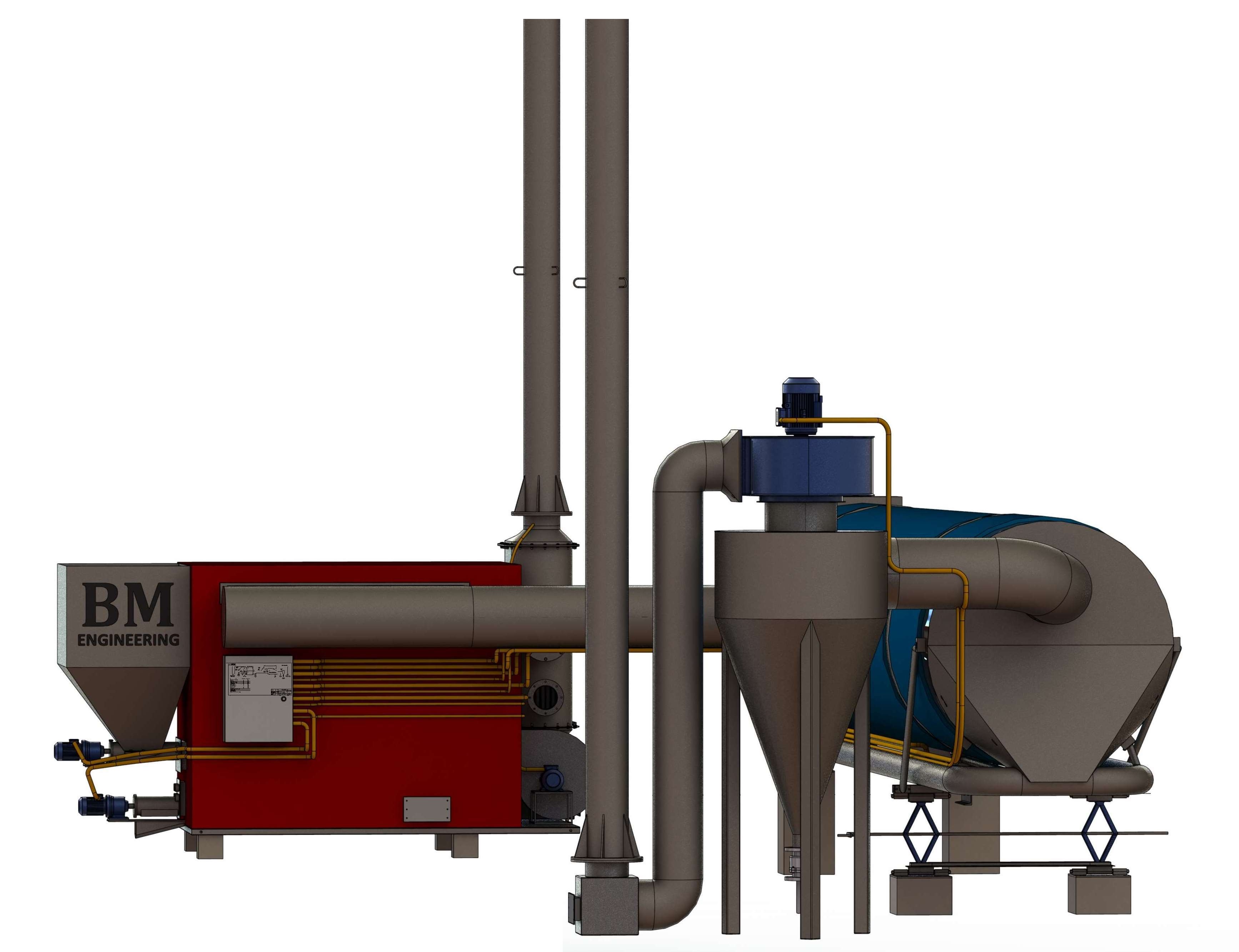
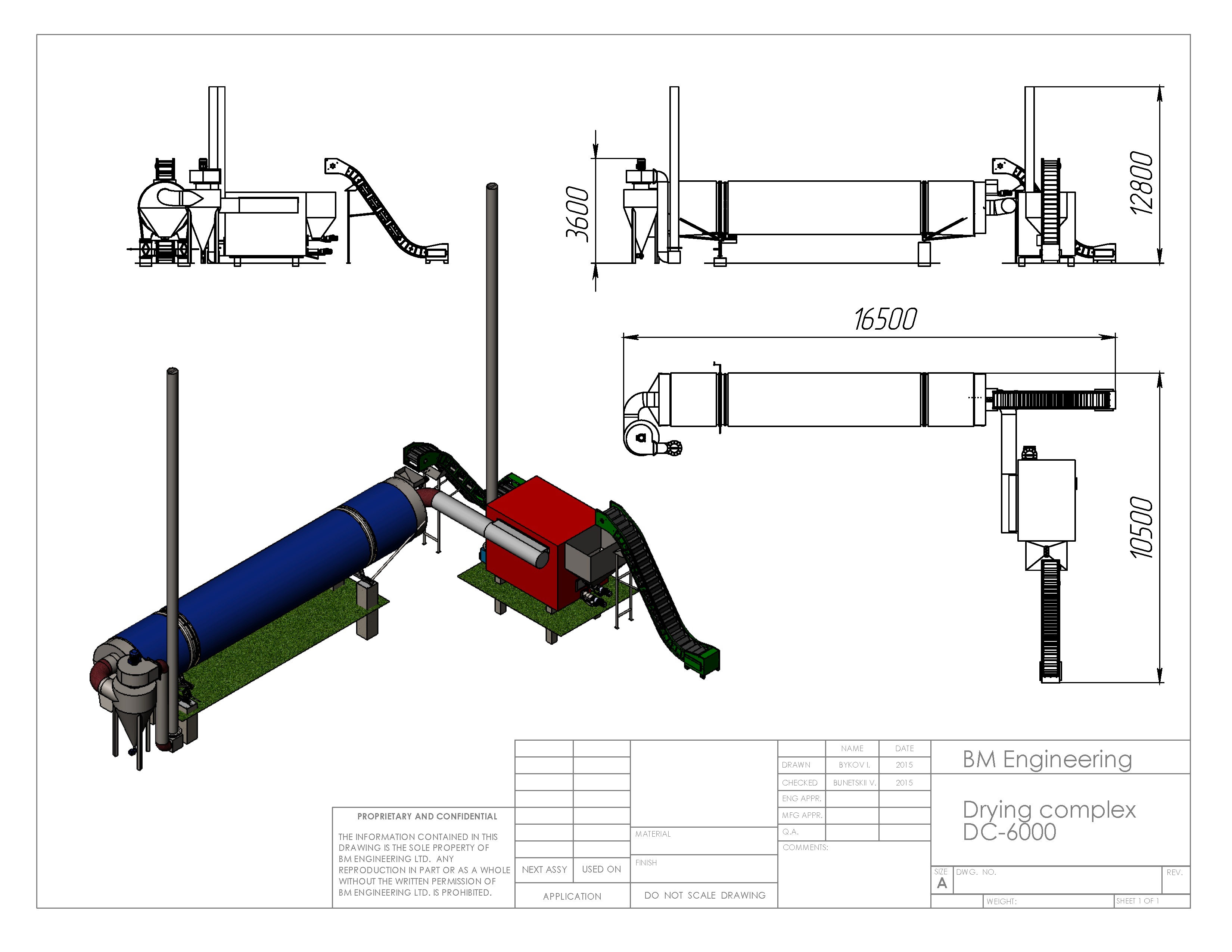
Drying Complex for biomass CK-3

The drying system for biomass (wood, grasses, agricultural waste and others.)

Specifications: Complex Kitting:
  • performance — up to 1000 kg / h;
  • electric power — 40 kW;
  • thermal power — 600 kW;
  • input materials: particle size — 4 cm, humidity — 60%;
  • dimensions — 16500*10500*12800 mm;
  • weight — 12700 kg.
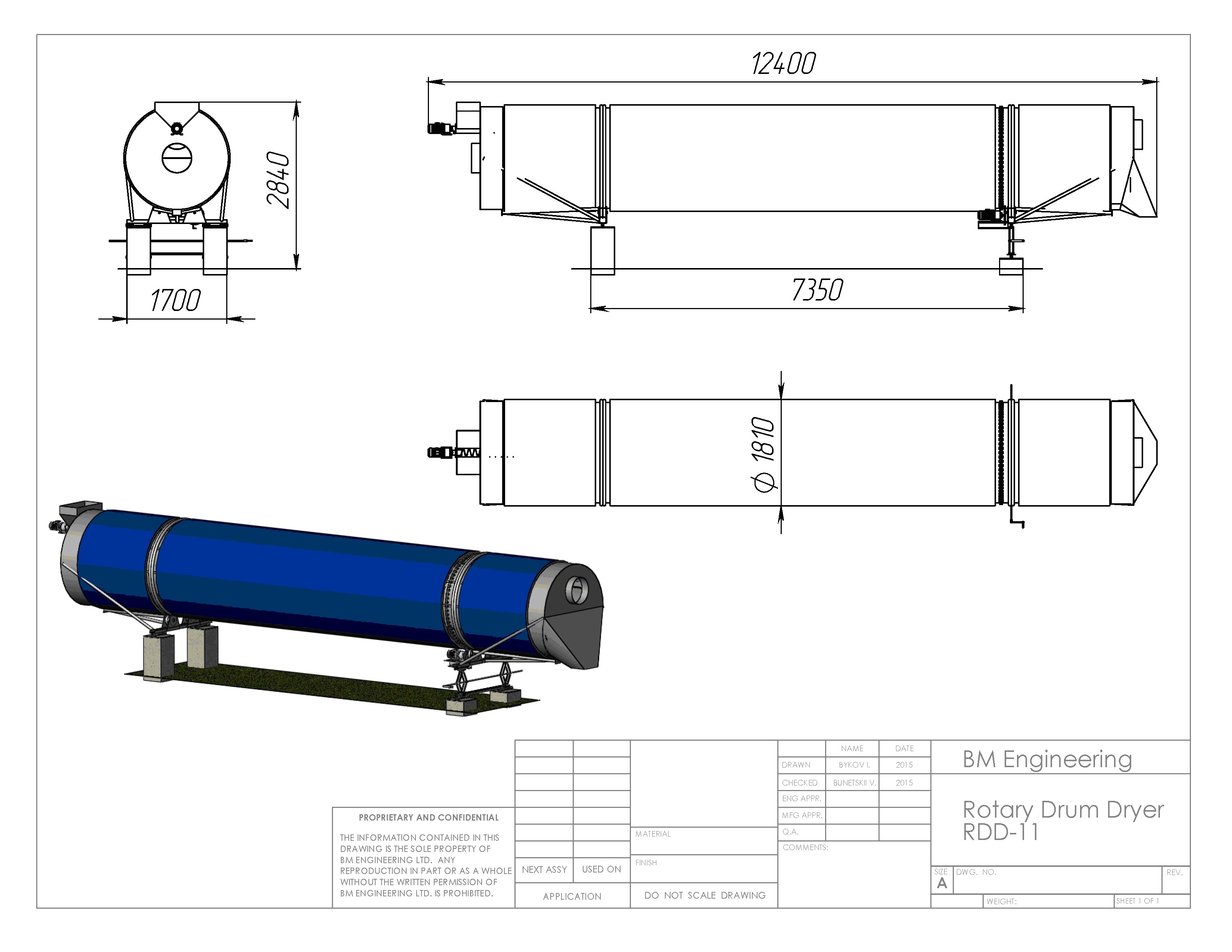
  • drum puddle dryer;
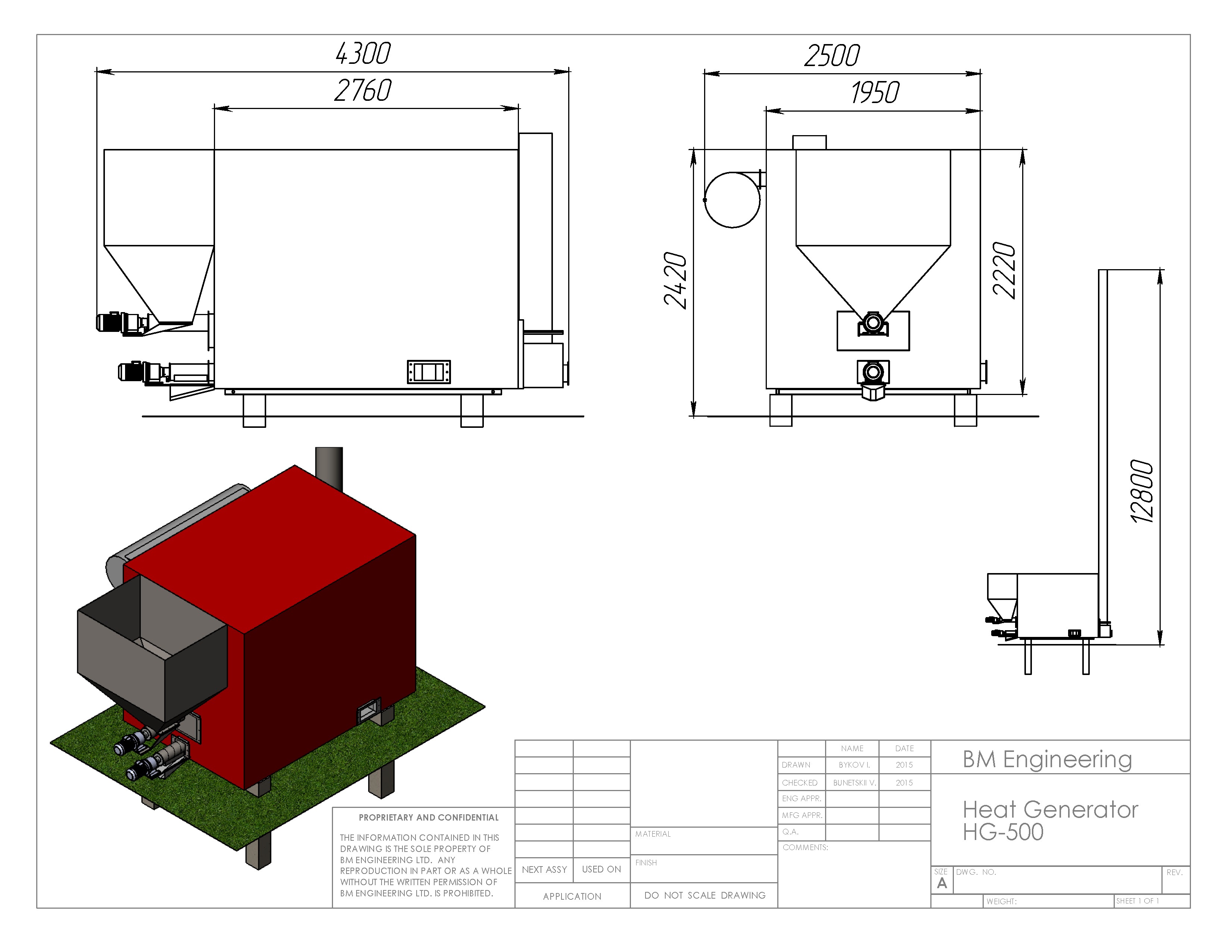
  • heat-generator with air heat exchanger;
  • aspiration unit;
  • raw material delivery unit;
  • deashing unit unit;
  • fuel supply unit;
  • smoke fumes utilizer;
  • aerodynamic transfer unit heating of dried material;
  • system automation process.

21 3 4 5

14-ck-3

The Drying Complex for biomass СК-3 is assigned for drying wood, grasses, agricultural waste and others kinds of biomass. Through the delivery unit biomass is fed into a drum paddle dryer. In a special heat-generator’s furnace wood waste burn and heat the air in the heat exchanger. The biomass particles come to aerodynamic transfer unit, where the moisture removed from them in a stream of air, and dried raw material heating. The smoke fumes utilizer passes preheated gas to the heat exchanger, which improves the energy efficiency of drying. Fuel is fed through the delivery unit as needed. The burned fuel’s ash is removed through a special deashing unit. All process is controlled by the automation system, operator involvement is minimal, it controls only the availability of raw materials to the delivery unit.

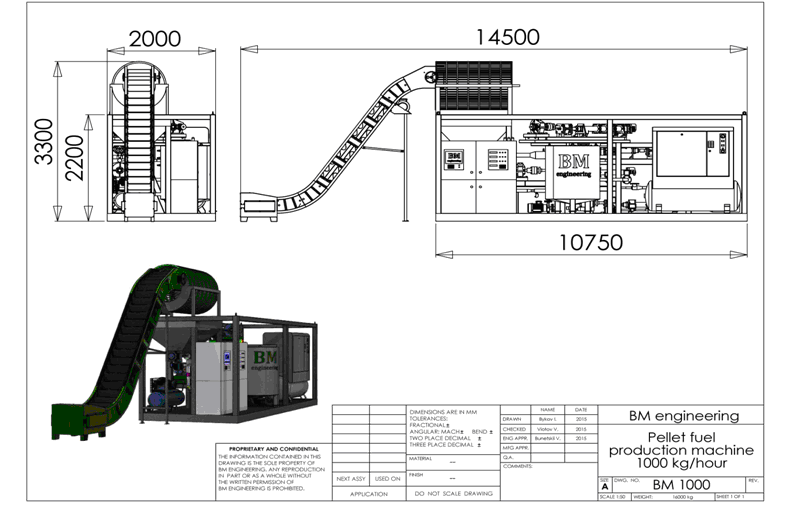
Biomass processing module МБ-3

Module Kitting:

  • Hydraulic washer;
  • Biomass processing module;
  • Heat pump;
  • Thermal stabilization unit;
  • Automation process system.
Technical characteristics of the biomass processing module МБ-3:

  • capacity — 1000 kg / h;
  • electric power — up to 100 kW;
  • Input raw materials: particle size — up to 4 cm, humidity — up to 50%;
  • transport dimensions – 2000*2200*12000 mm;
  • weight — 16700 kg.


11-mod-mb-3-1-en 12-mb3-0-en 13-mb-3-en

MB-3-shema

The unique biomass (wood chips and sawdust) processing module МБ-3 was designed by using the latest technology, which allows leaving biological materials not dried before pressing with large energy consumption. We wash it in hydraulic washer. Contaminants (metal, soil particles, dust) is removed by water stream. Wet and clean raw material particle by a conveyor and then through a sieve receives into the processing module input hopper.
Rotary screw grinds wet biomass and pushes it through a sieve. The biochemical reactions in the wood’s cells (biopolymers) generates heat. The optimum temperature of the hydrated mass thermal stabilization unit supports. Heat pump secure heated water circulation around the all-processing loop. The automation system check whole technological process.

Wood’s Microphotography

« 2 из 3 »