Specialized seminar «Pellet’s production industrial engineer»

18-ind-ingen 19-ind-ingen

Pellet’s production industrial engineer: activities description, job placement, basic requirements.
Biological raw materials (biopolymers) physical and chemical properties. Biomass Pelletization Technology: advantages and disadvantages.
New approaches to biomass grinding. The processing line for pellet’s production. Basic equipment. Engineering calculation of the manufacturing process and the negative consequences of incorrect calculations. Technical and economic analysis. Production and products certification basis.

At the seminar «Pellet’s production industrial engineer» we are ready to train higher technical educated specialists of various
professions: chemical or mechanical engineers, machine builders, food production process engineers, agriculture engineers,
specialists in bioengineering.
When, after our lectures and familiarity with working pellet’s production line, our listeners begin correct and deep understand
all modern various types of biomass processing principles, they will completely mastered in our approaches and principles.
What is the basis of our biomass processing technologies, we teach you:
 vegetable biological raw material is a mixture of biopolymers with different structure. To its processing (grinding and
subsequent pressing) you must approach taking into account the physicochemical and rheological biopolymer’s properties.
Not dried before grinding, use the wet raw material shearing which generates heat by mechanical the cell mass layers
relative displacement;
 in advance it is necessary to calculate each type of raw material processing regime, fulfill the specific equipment test
operation and choose the best processing mode. For conventional equipment, which is intended for dry material pressing,
such target setting can not be performed. It’s operation requires significant energy costs and additional maintenance
services;
 the recycling process is completely automated and does not require the personnel constant presence;
 in the case of a failure power blackout we provide the press cavity mechanical cleaning possibility. It allows continue it’s
operation after the power will be restored. Cold shredded biomass in the cavities of old equipment, resulting to all line
failure, complex and expensive recovery units and parts.
Technologists, who have been trained at our specialized seminar, never will use outdated inefficient
technologies. They will be able to organize at your enterprise profitable and modern pellet
production!


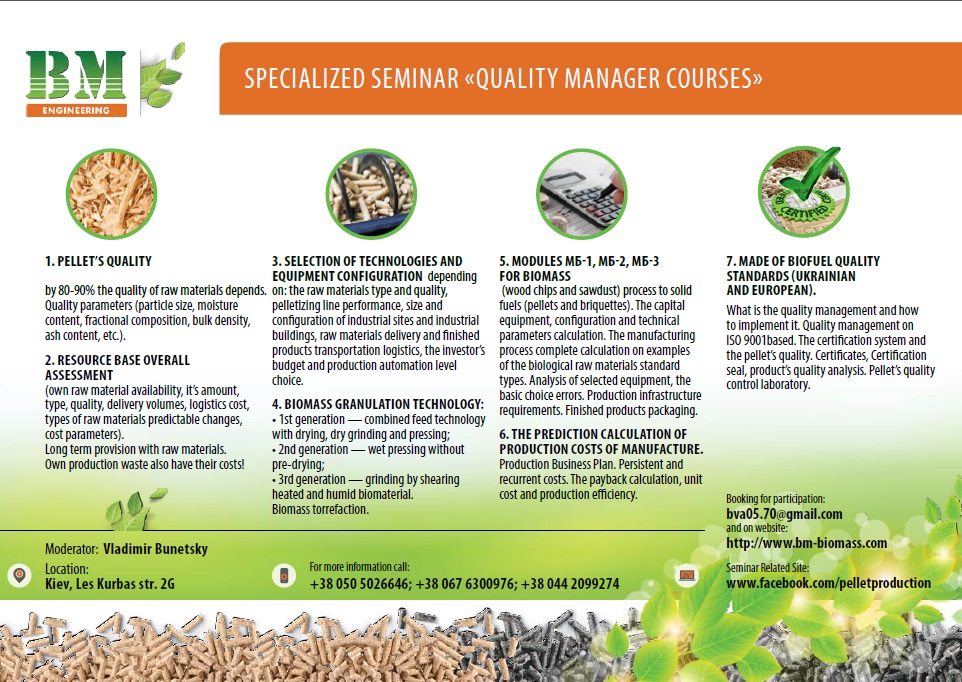
Courses for Quality pellet production Managers


22-qal-men 23-kurs-qal-men

Solid biofuels production engineering
1. Biomass Types and Properties.
2. Technologies and engineering instrumentalities for biomass
preparation, processing and using.
3. Technologies and engineering instrumentalities for biomass pressing
and pelletization.
4. Biomass Torrefication. Moist Pressing Technology.
5. Cost-effectiveness of biomass using.
Quality Management System
1. General information about merit rating and quality management.
2. History of the science of quality.
3. The process and characteristics of quality management.
4. Quality Management Methodical Bases.
5. Quality Management based on ISO 9000.
6. Processes and systems approach to Quality Management.
Approximate struc ture of the t raining program
Pellets Certification System
1. Certification System. Pellets Quality.
2. The Certificate.
3. The certificate seal. Following and transparency.
4. The administration of complaints procedure.
Payments.
The list of organizations that certify,
verify and test the pellet production.
5. Pellets Producers Requests. Pellet Manufacturing
Inspections.
6. Quality management of pellets producers.
7. Pellets Traders Requests.
8. Pellets Traders inspection tests.
9. P ellets Traders Quality Management.
10. Testing Pellets Methods and Tools

Seminar Biorefayning for agricultural sector

24-bioref 25-bioref

Raw materials

  • Wood’s Biorefayning in the Forestry
  • Agricultural raw material’s Biorefayning
  • Energy crops growing in the Agriculture and Forestry
  • The Biomass Waste local occurrence in Agriculture and Forestry
  • Harvesting and storage technologies of biomass. Logistics

Biomass processing

  • Classical processing technology
  • Melting Method Processing Technology
  • Processing Cost-effectiveness

Alternative Energy Sources

  • Biogas Plants
  • Liquid biofuels
  • MSW processing(municipal solid waste)
  • Hydropower engineering
  • Geothermal engineering
  • Solar power engineering
  • Wind power engineering

Power Generation

  • Cogeneration in Power Generation

Solid Biofuels (SB)Selling and using

  • Energy audit
  • Transportation and Storage Logistic
  • Biomass burning
  • Gasification
  • Layerwise Firing Circuit
  • Solid biofuels Sale, Logistic Warehouses, Exchange
  • Technological stages in the biomassprocessing.Internal and external market SB consumption

Topical Problems

  • Enterprise Energy audit
  • Grain dryers transfer on alternative fuel
  • Solid waste fuels from manufacturing waste (dead waste, disposal fields)
  • Wind belt Reclamation(Forest plantations)
  • Cane Harvesting
  • Tops and Roots
  • Pellet’s production, questions from A to Z
  • Biochar

In the harvesting process and agricultural products processing we remain solid waste. In
recent years, the special energy crops cultivation is expand. This biomass creates a diverse
raw materials source not only for biofuel production, but also for the full biorefining —
high-tech production with high value-added cost based on deep mechanical and chemical
processing biological raw materials directly in the region of its growth.
Biorefining includes:

    • deep chemical processing for a pulp and a variety of organic substances producing;
    • agricultural sector waste energy recycling to finished biofuels;
    • chemical processing for a pellets, torrefied fuel, ethanol, biological products producing;
    • construction materials production, based on polymers;
    • food grain, microcrystalline cellulose receiving;
    • medicinal agents production.

Sharing automated control systems and second-generation biofuels (pellets) using in industrial and individual automation heating systems will allow not only go to the «green» housing construction, but also reduce the agricultural production and processing cost by cogeneration own «green» energy.

Seminar Pellet’s Production Foundations

16-fond-pel-prod17-found-pel-prod

Some companies began to create Ukrainian pellet’s production in the forestry and agricultural sector in the past 10 years. They mainly used obsolete equipment designed for the mixed fodder manufacturing. They does not take into account the fundamental
differences in technologies and, consequently, in the equipment design. Company «BM-Engineering» offers in essence new
approaches to pellet’s production creation. It is necessary to use for biomass processing such technologies, that take into account
physical and chemical properties, characteristics of raw materials and allow you to control the quality of products at all stages of
production.
Our correct approach to the of biomass lines processing creation is in:
. feedstock don’t need drying with high energy costs. It needs to be washed and heated and then milled through the use of
shear strain between the biopolymer layers and melting;
. grinding mode is completely determined by the physicochemical and rheological properties of raw materials in a particular
party. The technical regime characteristics must be chosen by trial operation with the technical process parameter changes
step by step in accordance to the procedures offered by our company;
. you must have fully automated processing lines;
. we propose special mechanism for raw material residues removal from the inner cavity in case of equipment power failure.
We offer pellet’s producing lines with different manufacturing capability. They cover an industry
equipment needs range, taking into account the volume of the raw material base and the types
of feedstock.